
Most real estate agents know how many homes they closed last year. Far fewer know the numbers that actually created those closings.
One of the biggest differences between top-producing agents and struggling agents is that top producers manage their business based on numbers, not feelings. They do not wake up wondering if they are busy enough, working hard enough, or having a good month. They look at the data.
If you want predictable growth in your real estate business, there are five numbers you should track every single week.
Why Numbers Matter More Than Feelings
Feelings can be misleading.
You can feel busy while your pipeline is shrinking. You can feel discouraged while your business is actually growing. You can feel productive while avoiding the activities that generate income.
Numbers tell the truth.
Top agents know exactly how many conversations, appointments, contracts, and closings they need to hit their goals. Because they track their numbers consistently, they can make adjustments before problems become serious.
Number 1: Conversations
Everything starts with conversations.
A conversation is any meaningful discussion about real estate with a lead, past client, referral partner, sphere contact, buyer, or seller.
This is often the most important number in an agent's business because conversations create opportunities.
No conversations means no appointments.
No appointments means no contracts.
No contracts means no closings.
Many agents focus on how many calls they made. Top agents focus on how many conversations they had.
Number 2: Appointments Set
The next number is appointments set.
This includes listing appointments, buyer consultations, coffee meetings, virtual consultations, and referral meetings.
Appointments are where relationships begin to turn into business.
If your conversation count is high but your appointment count is low, you may need to improve your scripts, confidence, or ability to ask for the appointment.
Number 3: Appointments Met
Not every appointment actually happens.
That is why successful agents track appointments met separately from appointments set.
This number helps identify whether people are showing up and whether your appointment confirmation process is working.
Many agents are surprised when they discover how much business they lose between setting and actually holding appointments.
Number 4: Contracts Written
Contracts written tell you whether your appointments are converting into business.
If you are meeting with plenty of people but not writing contracts, it may point to an issue with your presentation, consultation process, follow up, or negotiation skills.
Tracking contracts written helps you understand whether your efforts are moving people toward action.
Number 5: Closings
Closings are the final result of everything else.
Most agents focus heavily on closings because that is where income is generated.
The problem is that closings are a lagging indicator.
By the time a closing happens, the work that created it may have happened 30, 60, or even 90 days earlier.
Top agents pay attention to closings, but they focus most of their energy on the activities that create future closings.
How the Numbers Work Together
Think of your business like a funnel.
Example progression from conversations to closings.
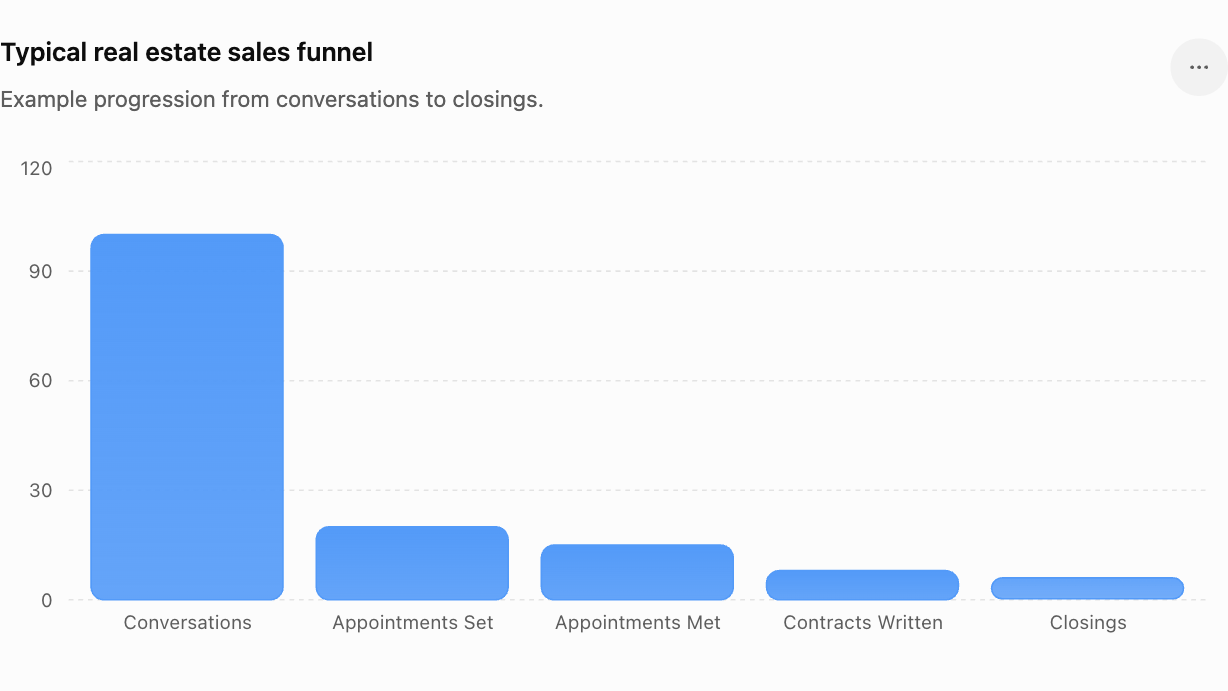
Your exact numbers will be different, but every agent has conversion rates between these stages.
Once you know your numbers, you can predict your future business with much greater accuracy.
For example, if you know that every 100 conversations typically results in six closings, you can work backward from your income goals.
Top Producers Track Leading Indicators
Average agents focus on results.
Top producers focus on activities.
They know that if conversations, appointments, and contracts are increasing, closings will eventually follow.
When their numbers start slipping, they catch the issue early because they are tracking leading indicators rather than waiting for their income to tell them something is wrong.
What to Do Next
Start tracking these five numbers every week:
- Conversations
- Appointments Set
- Appointments Met
- Contracts Written
- Closings
Do it for the next 90 days.
You will quickly identify where opportunities are being lost and where improvements can have the biggest impact.
The agents who consistently grow are not guessing their way through business. They know their numbers, they monitor their progress, and they make decisions based on facts instead of feelings.
That is what turns real estate from a hobby into a predictable business.